Beiträge von TendStack

    Hey Copro,

    Thank you again for your detailed report! We got to work on it right away, and we are happy to share that most of your observations have been addressed. The onboarding process and user menu are now fully translated, along with most other areas we could find. Additionally, the PWA banner is now compact, less intrusive, and out of the way.

    Please give it a try when you get a chance, and let us know if you notice anything else we can do to improve the app. Thanks again for your help!

    Have been using the OndaCast platform before I love the instant streaming option without even having to register an account. And since it is running on netcup server this makes it even more interesting - so thank you for showcasing another project!

    So far I just have some feedback for improvements for the platform but most of it is just cosmetics for a streaming platform or hub.

    There is no information about the current version of the OndaCast platform which makes reporting bugs or feedback fall back to date or timestamps.
    The German translation which I checked is only available for parts of the menu and does not cover the complete site like banners, login or other details yet.

    When the notification to install the app it is displayed under the title menu, but also overlayed by the menu on the left, which cuts off some of the text.

    Thank you so much for your feedback! We're thrilled to have you as a returning user. Please feel free to share any suggestions or report any issues you come across. Your input really helps us grow and improve the platform.

    Hi everyone in the Netcup Community,

    I’d like to introduce OndaCast.com, an independent audio and podcasting platform built to put creators and listeners first.

    What is OndaCast?

    OndaCast was born out of a desire to support independent publishers and audio creators. Big tech platforms often lock creators behind closed ecosystems, paywalls, and heavy algorithms. Listeners, on the other hand, are bombarded with intrusive ad trackers and bloated interfaces.

    We built OndaCast to provide a clean, high-quality audio hub where listeners can discover independent shows, podcasts, and live radio stations—completely free of tracking bloat and invasive ad networks.

    Championing the Open Web: Podcasting 2.0 & Value4Value

    A major cornerstone of OndaCast is our commitment to Podcasting 2.0 standards:

    • True Ownership: Creators retain complete ownership of their content via open RSS standards, without being bound to walled gardens like Spotify or Apple.
    • Rich Metadata: Podcasting 2.0 enables creators to embed transcripts, chapters, video elements, and rich interactive show notes natively in their feeds without paying hefty platform distribution fees.
    • Direct Creator Support (Value4Value & Boostagrams): Listeners can support creators directly using Value4Value micropayments and send Boostagrams (streaming sats/tips with attached feedback messages). This directly connects audience appreciation with creator sustainability.

    Why We Chose Netcup

    As an independent project, we operate without the massive venture capital budgets of industry giants. Reliability, network performance, and predictable, cost-effective pricing are critical for us:

    • Unmatched Price-to-Performance: Netcup offers an unbeatable balance of affordability and robust hardware specs, allowing us to keep server overhead manageable while scaling.
    • Reliability & Stability: Streaming audio and handling dynamic RSS parsing requires stable uptime, and Netcup’s infrastructure has consistently delivered.
    • Independence: Netcup's developer-friendly environment gives us full freedom over our software stack and data sovereignty.

    We’d Love Your Feedback!

    We invite you to check out OndaCast.com. Whether you are a podcast enthusiast, an independent creator looking for a platform, or a fellow developer interested in Podcasting 2.0 integrations, we’d love to hear your thoughts, feedback, and suggestions.

    Thank you to the Netcup team and this great community for making projects like this feasible for independent builders!


    That is more of a jump scare ;) ... but the link is another 404 like the GitHub repository.

    But keep it simple and straightforward and focus on the control panel until a first release.

    Just my two cents for the nice feature of having an image gallery with multiple cloud sources ... this would not be something I want on my server control panel. Even in my private home NAS where such an application would be more than welcome, containing most of the images I would not willingly put them on "small" public or free cloud storage providers for 5 - 20 GB but either one big one that I trust and will be paying for the secure storage or host them directly on my own server(s). :/

    Thank you so much for your input—I will absolutely take it into account.

    Just to clarify, even though this control panel can be installed directly on the server box, the recommendation is to host it either on a private (non-main-server) machine or on a small, inexpensive ($5.99) dedicated VPS.

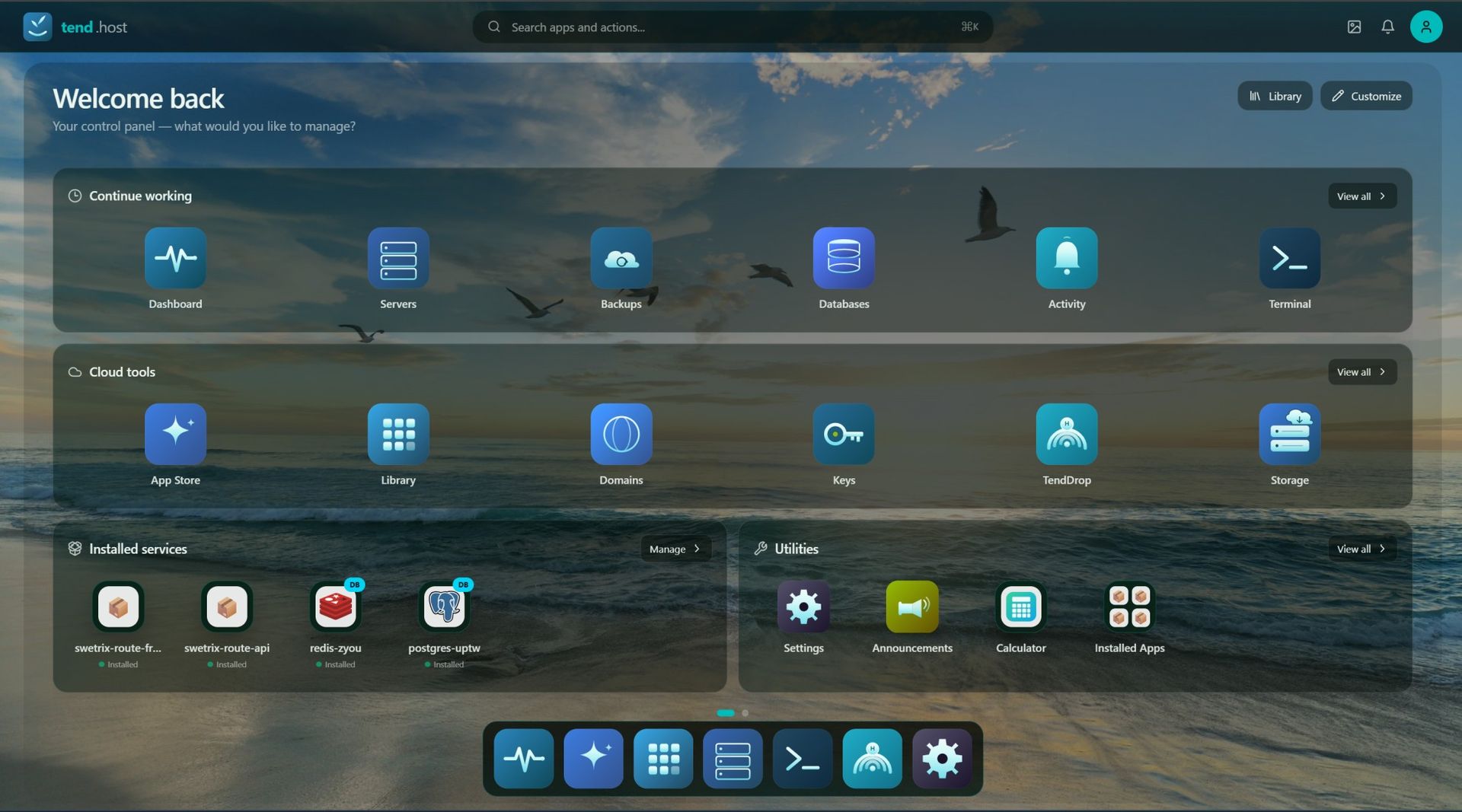
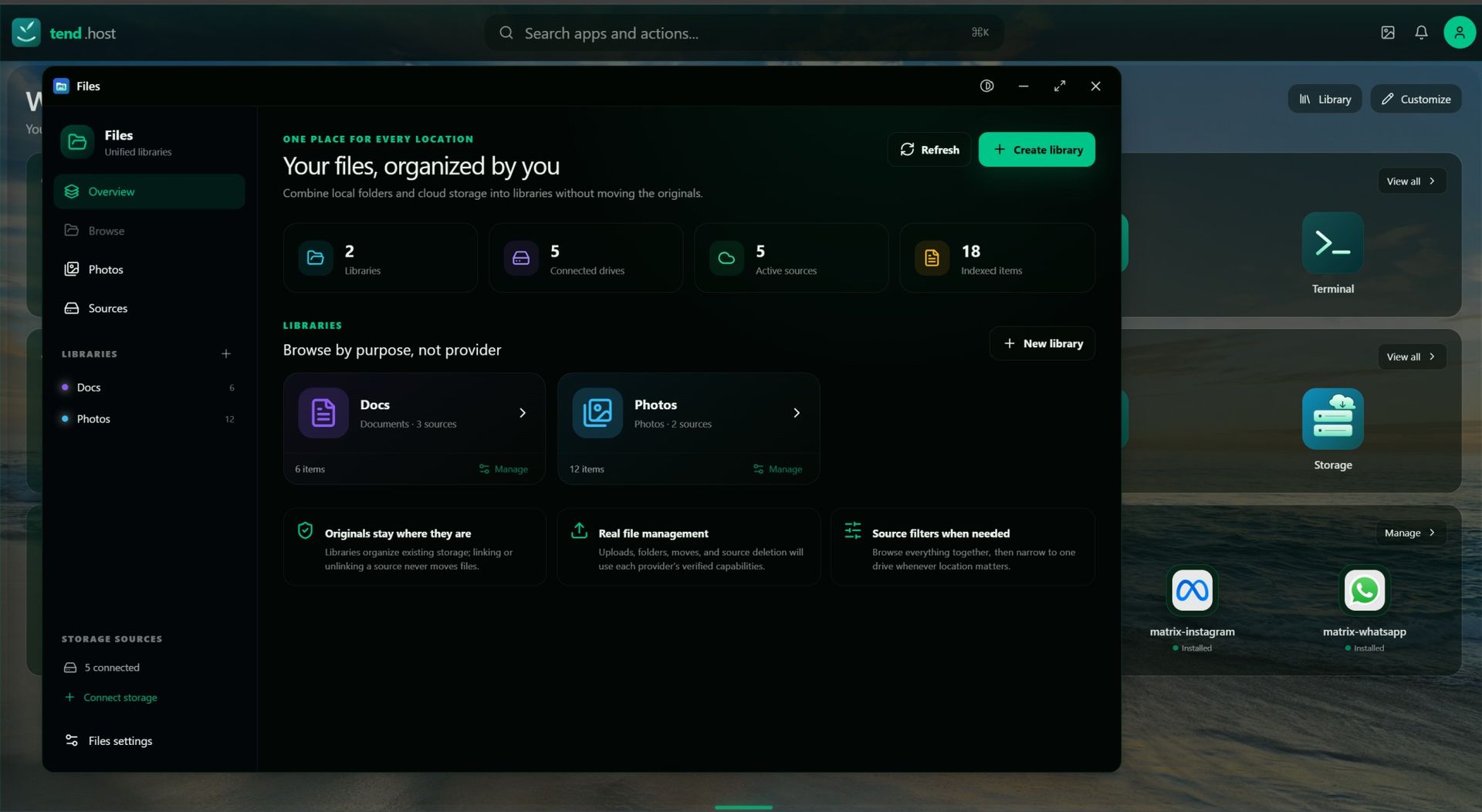
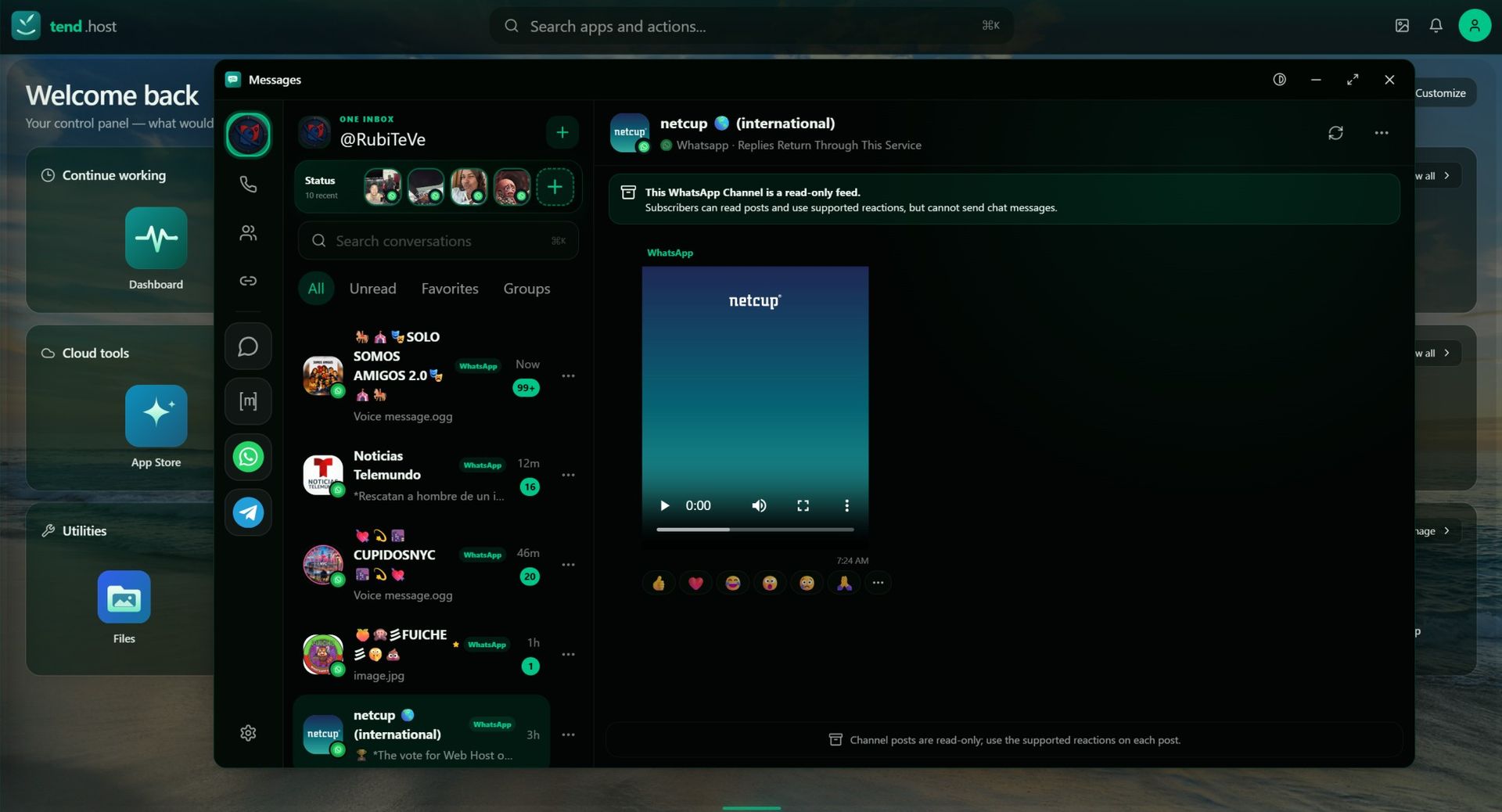
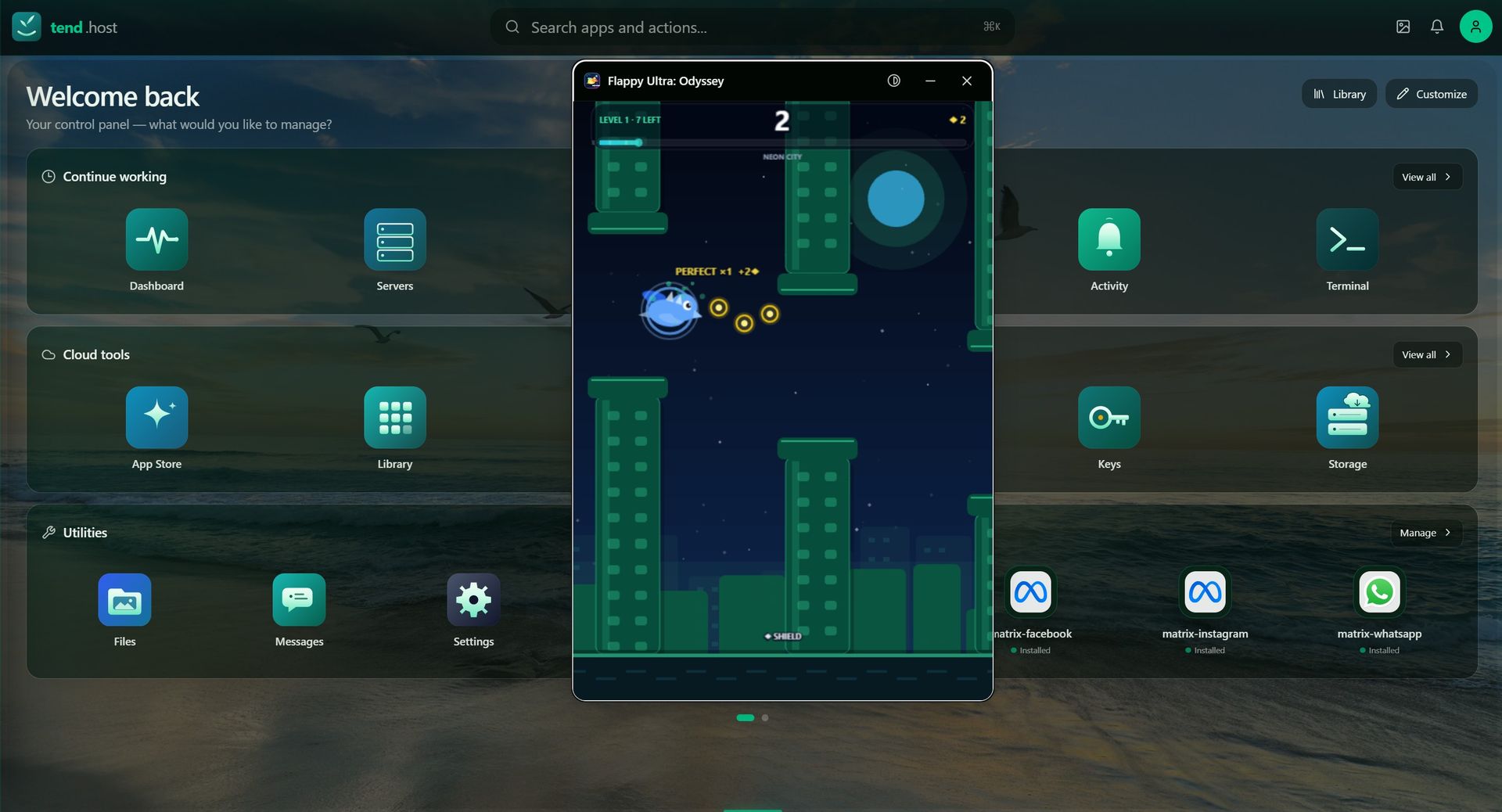
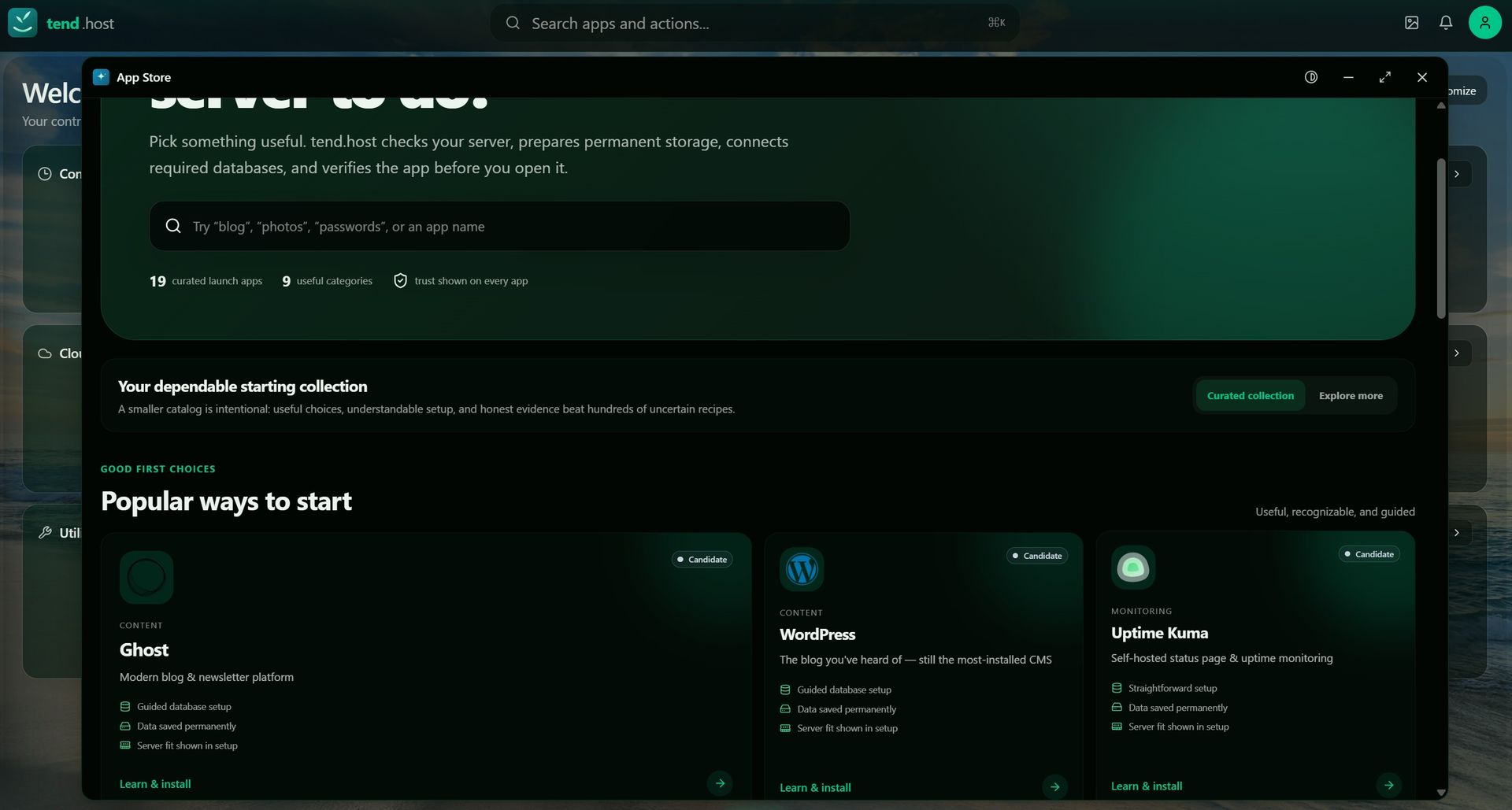
    What you see is a production environment where the icons represent apps installed by the user; they are not mandatory or included by default. Features like the file manager, however, are native to the panel.

    The panel itself can easily run on 1 shared vCPU and 1 GB of RAM. To put this into perspective, in a clean, real-world deployment managing 20 application records across 3 servers, the tend.host container used about 125 MiB of RAM, Caddy used about 63 MiB, and the entire Linux host sat at around 0.9 GiB of used RAM at idle.

    Actual resource usage will vary based on deployment activity, enabled integrations, the operating system, Docker caching, and overall workload size, so the recommended specifications above intentionally include plenty of headroom.

    More than just web hosting servers.

    You can also manage buckets from major providers—and even your Google Drive. Combine buckets, files, and images from different providers to view them all in a unified file manager. Move files seamlessly from one provider to another, and view your pictures in a beautiful gallery.

    This is ideal for users with free tiers across multiple cloud services: combine your 5 GB, 10 GB, and 20 GB tiers, distribute your photos among them, and browse everything in one gallery as if it were stored on a single drive.


    Which authentication methods are planned for the initial release of tend.host?

    Native WebAuthn/FIDO2 support would be particularly important to me. The panel is intended to have extensive administrative access through SSH and the Docker socket. If it is operated as an externally accessible service, phishing-resistant authentication should therefore not be an optional feature to be added at some later point. Passwords and TOTP alone are no longer appropriate for this in 2026.

    I regularly criticize other projects where FIDO2 apparently was not considered from the beginning despite its age, often without even an issue being opened for it. That is why I prefer to ask during the first announcement, while the repository cannot yet be reviewed publicly.

    Is FIDO2 already planned? OIDC would also be useful as an additional option, but should not replace native support.

    Thank you for your comment, Thomy.

    I feel your pain, and that was actually one of our main motivations for creating tend.host. I honestly can’t comprehend how, in 2026, there are still control panels that haven't even implemented 2FA. It doesn't matter how well you secure the server if you’re basically leaving the front door unlocked!

    But we have good news: This is already implemented, as security is our top priority.

    Plus, we support passwordless logins! Regardless of your login method—whether using a passkey or a regular password—2FA is always enabled by default, making that second layer of security mandatory. We also do not support email or SMS recovery, as both methods are easily compromised.
    The only way to recover an account is by using the recovery code generated when the account was first created (which can also be regenerated from within the account panel) or by using a passkey added from a FIDO key or another device. The user can add more than one Passkey as a security layer to avoid getting locked out in the event they loses one key and recovery codes all together. Unlikely to happen, but it could.
    We thought about disabling password all together, but realize this would confuse many users; mandatory 2FA seemed like the best approach.


    P.S. On a brand-new VPS, tend.host performs an initial security audit and applies essential safeguards before installing any applications. It then periodically scans the server and installed apps for security vulnerabilities, kernel updates, and OS patches. You can apply these updates manually with a single click or set them to run automatically—though auto-updates carry a slight risk for applications sensitive to dependency changes. This can be implemented to a VPS that was setup before using tend.host to manages it, but that will require a little bit more of work from the user.

    Additionally, whenever you deploy or update a container, tend.host runs a health check to ensure it meets strict pass criteria. If a check fails, you’ll receive detailed error logs explaining what went wrong. This especially includes security checks. Your live site stays uninterrupted throughout the process, as the previous container remains active and the broken build is never pushed live.


    BTW: tend.host can be setup to run locally with zero access from the outside world.

    Thank you for the insights and honesty about having been caught already and your key learnings of operating a VPS or RS on the internet. Maybe change the title of the post to something more suitable like: "Securing your server against unauthorized mining", because it does not seem to advertise unauthorized mining :saint:

    From the screenshot I can see you have a RS 2000 G12 setup - so yes that is a mighty weapon that can be used for an attacker and unauthorized mining is just one of the many bad things such a server can be used for. Typically the recommendation is to restore the server with a fresh install of your favorite server OS and then restore the services from a clean backup after all updates, patches and hardening is done.

    There are even some basic community tutorials for the english speaking part of the forum available:
    First steps to secure your Linux server

    Title changed to something more appropriate. Thank you!

    Hey everyone,

    I've seen a lot of posts on Reddit from people who get caught off guard when their VPS gets suspended for high resource usage or suspected crypto mining. Honestly, Netcup’s hardware performance is fantastic for the price—and that’s exactly why malicious actors target these instances.

    Disclaimer: There really isn't a catch with Netcup and that's why I am posting this, I am not getting paid. I simply have been with a lot of providers during my web development journey, and NetCup have definitely set the bars for me, and that is the only reason for this post.

    So, yes, Netcup is great, but you do need to know how to properly lock down your environment. Otherwise, an unmonitored server will eventually get compromised.

    The hidden miner headache

    Unauthorized mining is a huge issue. I had to learn this the hard way a while back—attackers don't just drop a miner and leave. They set up persistent, self-regenerating scripts, hidden cron jobs, and sleeping background processes. You clean up the binary, think you're clear, and then a week later it's right back. If you have been there, you know the frustration 😤

    Usually, the attack vectors come from legacy workflows or unpatched control panel vulnerabilities. If you're running old PHP setups or unmaintained Webmin/cPanel, CloudPanel, IP Config or any similar alternatives, it’s only a matter of time.

    Practical steps to secure your server

    If you want to avoid waking up to an abuse notification, here are the main things you should lock down from day one:

    • SSH Hardening: Ditch plain FTP immediately. Use SSH/SFTP only with key-based authentication (ed25519 keys). Disable password authentication completely (PasswordAuthentication no) and disable direct root login (PermitRootLogin no). Also, consider changing the default SSH port to cut down 99% of botnet brute-force noise in your logs.
    • Firewall & Intrusion Prevention: Run ufw or iptables and default to dropping all incoming traffic except what's explicitly needed (e.g., 80, 443, custom SSH). Pair this with Fail2ban or CrowdSec to automatically block IP addresses spamming SSH or HTTP endpoints.

      Netcup have Firewall directly in your server control panel, I don't know why anyone wouldn't use it. Please use it as an extra layer of defense.
      netcup.jpg
    • Modern Stacks & Containerization: If possible, isolate applications using Docker or LXC. If a vulnerability in one service gets exploited, containerization keeps the attacker trapped in an unprivileged container rather than getting immediate root access on the host node. If you're moving toward newer tech (SvelteKit, Bun, Go, Python, etc.), keep dependencies lean and regularly audited. If you must run legacy WordPress/PHP apps, use automated patch tools and strict file permission masks (chmod/chown).
    • Process & Resource Isolation: Use systemd cgroups or Docker resource limits (--cpus, --memory) to limit what a single process can consume.
    • Zitat

      Never give a single process or application unrestricted access to all your server's resources—even if it's the only app you're running.

    • If a miner does manage to execute, strict cgroups prevent it from hogging 100% of the CPU and triggering Netcup's automated host-node load flags.
    • Active Monitoring: Don't rely solely on Netcup's panel to tell you something is wrong. Set up basic monitoring (htop, glances, or lightweight tools like Netdata) alongside alerts for unexpected CPU spikes, unauthorized cron modifications (crontab -l, /etc/cron*), or unusual outbound network connections on non-standard ports.

    When Netcup suspends an account for excessive CPU or unauthorized mining, it's rarely a mistake—the automated system caught a runaway process or a compromised box before it impacted neighboring tenants on the hypervisor.

    Lock your stuff down properly before deploying live workloads, and you won't run into issues here. Hope this helps anyone setting up a fresh node!


    Hallo zusammen,

    ich möchte euch heute tend.host vorstellen — ein Open-Source-Control-Panel, an dem ich arbeite und das sich ideal für VPS- und Server-Setups bei netcup eignet.

    ❓ Warum noch ein Control Panel?

    Wer eigene Server oder Applikationen hostet, kennt das Dilemma: Komplexe Docker-Setups, Command-Line-Jonglieren, manuelle SSL-Zertifikate, Restic-Backups per Cronjob und die ständige Sorge um Sicherheits-Updates. Viele vorhandene Panels setzen tiefes Wissen über Reverse Proxies und Container-Netzwerke voraus.

    tend.host ist das Control Panel für den Rest von uns:

    • Klar verständliche Oberflächen ohne Fachjargon
    • Sicherheit out-of-the-box
    • Volle Kontrolle über eure eigene Infrastruktur – ohne Hersteller-Lock-in

    🚀 Die wichtigsten Features im Überblick

    • 1-Klick App-Deployments: Direkt aus Git-Repositories, Docker-Hub-Images oder docker-compose-Dateien.
    • Integrierter Restic-Backup-Manager: Automatisierte Volume-Backups, S3/Object-Storage-Support, Aufbewahrungsregeln und Wiederherstellung mit Sicherheits-Snapshot.
    • Server-Hardening & Audits: Basisschutz für frische VPS (UFW, Fail2ban, SSH-Schlüssel, Kernel-Härtung) und fortlaufende Security-Scans.
    • Caddy Reverse Proxy & Automatische SSL-Zertifikate: Vollautomatische Routing- und TLS-Verwaltung für eure Domains.
    • Kein Agent auf Zielservern: Verbindet sich einfach via SSH und Docker-Socket. Minimaler Footprint auf euren Hosts.
    • Moderne UI: Gebaut mit Svelte 5, FastAPI und SQLite — schnell, schnörkellos und inkl. Command Palette (Ctrl + K).

    🛠️ Technischer Stack

    • Frontend: Svelte 5, TypeScript, Tailwind CSS v4, DaisyUI
    • Backend: Python 3.12+, FastAPI, Uvicorn, SQLite, PostgreSQL
    • Orchestrierung: Docker Engine, Caddy, Restic, APScheduler

    🔗 Links & Mitmachen

    Das Projekt ist quelloffen und wird aktiv weiterentwickelt. Feedback, Feature-Wünsche und Vergleiche mit euren aktuellen Setups sind sehr willkommen!

    tend.host — We’re tending the garden

    Ich freue mich auf euren Input und eure Meinungen!

    ENGLISH-SPEAKING

    The Fair-Code Control Panel for App Deployments, Backups & Server Management

    Hi everyone,

    Today I’d like to introduce tend.host — an open-source control panel I’ve been building that’s designed to run seamlessly on VPS and server setups.

    ❓ Why another control panel?

    Anyone hosting their own servers or applications knows the drill: complex Docker setups, juggling terminal commands, manual SSL certificate setups, Restic backups via cron jobs, and constantly worrying about security patches. Many existing control panels require a deep understanding of reverse proxies and container networks.

    tend.host is the control panel for the rest of us:

    • Clear, easy-to-understand interfaces without jargon
    • Security out-of-the-box
    • Full control over your infrastructure — zero vendor lock-in

    🚀 Key Features at a Glance

    • 1-Click App Deployments: Deploy directly from Git repositories, Docker Hub images, or docker-compose files.
    • Integrated Restic Backup Manager: Automated volume backups, S3/Object Storage support, retention rules, and safety-snapshot restores.
    • Server Hardening & Audits: Baseline protection for fresh VPS setups (UFW, Fail2ban, SSH keys, kernel hardening) and ongoing security scans.
    • Caddy Reverse Proxy & Automatic SSL: Fully automated routing and TLS certificate management for your domains.
    • Agentless Managed Servers: Connects via standard SSH and Docker socket. Minimal footprint on target hosts.
    • Modern UI: Built with Svelte 5, FastAPI, and SQLite — fast, clean, and includes a built-in Command Palette (Ctrl + K).

    🛠️ Tech Stack

    • Frontend: Svelte 5, TypeScript, Tailwind CSS v4, DaisyUI
    • Backend: Python 3.12+, FastAPI, Uvicorn, SQLite, PostgreSQL
    • Orchestration: Docker Engine, Caddy, Restic, APScheduler

    🔗 Links & Getting Involved

    The project is fully open source and under active development. Feedback, feature requests, or thoughts on how it compares to your current setup are always welcome!

    tend.host — We’re tending the garden

    Looking forward to hearing your thoughts and feedback!
    Comming soon...